






Introduction
Every avocado recipe on the internet seems to end the same way: toast. Mashed avocado on toast, avocado and egg on toast, avocado toast with chilli flakes, avocado toast with a poached egg — the same idea repeated with minor variations, as if toast is the only dish avocado was ever meant to sit on.
If you’re new to the fruit altogether, our homepage has a full range of frozen fruit products worth browsing before you dive into these five ideas.
That’s a fairly narrow way to treat a fruit this versatile, especially in a kitchen tradition as rich as Gujarat’s, where creamy, mildly flavoured ingredients like curd, besan and coconut already play a starring role in dozens of dishes. Avocado’s texture — buttery, neutral in flavour, a little nutty — actually slots into Gujarati cooking more naturally than most people expect. It just needs someone to point out where.
Here are five ways to use avocado that have nothing to do with a slice of bread, built around flavours and formats that already feel familiar in a Gujarati household.
1. Avocado Chaas (Buttermilk)
Chaas is practically a daily ritual in Gujarati homes, especially through the hotter months — usually made with curd, water, roasted cumin, and a bit of coriander or curry leaf. Adding avocado to the mix turns a light, thin drink into something considerably more filling, closer to a light meal than a beverage.
Blend a thawed it with curd, chilled water, roasted jeera powder, a pinch of black salt, and a few coriander leaves. The avocado adds a subtle richness without overpowering the tang of the curd — it doesn’t taste like “avocado chaas” so much as an unusually creamy, satisfying version of the chaas you already know. This works particularly well as a filling mid-morning drink, replacing a heavier breakfast on a busy day.
2. Avocado Thepla
Thepla dough traditionally gets its softness from curd or oil worked into the flour. It, mashed and mixed directly into the dough along with the usual methi, turmeric, red chilli powder and a little ajwain, does a similar job — the fat content keeps the theplas soft for longer, even a day or two after making, which is exactly the quality that makes thepla a popular travel food in Gujarati households.
Mash a thawed avacado slice thoroughly and knead it into your regular thepla dough in place of some of the oil or curd. Roll and cook as usual. The green tint is barely noticeable once the spices are mixed in, and most people trying it for the first time won’t immediately guess what the softness is coming from.
3. Avocado Dal, Finished With a Spoon at the End
This one isn’t a dal recipe built around avacado — it’s a small trick added to a dal you already make. Once your regular toor dal or moong dal is fully cooked and tempered, stir in a spoon of mashed avacado just before serving.
It melts into the hot dal, adding a subtle creaminess without the heaviness of ghee or cream, and without changing the dal’s flavour profile in any obvious way. It’s a genuinely useful trick for anyone trying to make meals feel a bit more filling and nutrient-dense without reaching for extra dairy or fried tempering. Try it once with a small amount before committing a whole avacado to a big pot — a little goes further than you’d expect.
4. Avocado and Coconut Chutney
Green chutney is a fixture alongside dhokla, khandvi, handvo, and most Gujarati snacks. Swapping in avacado for part of the usual coriander-mint base creates a noticeably richer, creamier chutney that still carries the familiar tang and heat.
Blend a thawed avacado slice with fresh coriander, mint, green chilli, a small piece of ginger, grated coconut, lime juice and salt, adding a splash of water to loosen it to the right consistency. Serve alongside dhokla or khandvi exactly as you would regular green chutney. The coconut and avocado together create a texture that clings well to steamed snacks, and the flavour holds up better than a purely herb-based chutney does after sitting for a few hours.
5. Avocado Undhiyu-Style Sabzi Addition
This is the most experimental of the five, and worth trying with an open mind. Undhiyu and other mixed-vegetable Gujarati sabzis often include a range of textures — some soft, some firm, some starchy. Adding diced avacado toward the very end of cooking, just before serving, introduces a buttery, almost surprising texture against the more traditional vegetables.
Because it breaks down quickly with heat, it should go in last, off the flame or with only a minute or two of residual cooking, tossed gently so the pieces hold some shape. This isn’t a traditional preparation by any means, but for households already comfortable experimenting with their weekly sabzi rotation, it’s a genuinely interesting way to introduce a new texture into a familiar dish.
Why Frozen Avocado Makes These Five Easier, Not Just Possible
Each of the ideas above technically works with fresh avacado too — but fresh avacado brings a timing problem that frozen avacado simply doesn’t have.
Fresh avacado has a narrow ripeness window, often just a day or two of good eating condition. If you’re planning to make thepla dough on a Tuesday, you need an avacado that happens to be exactly ripe on Tuesday — not two days too early, not two days too late. In practice, this rarely lines up, which is a large part of why most people who buy a fresh avacado “to try a recipe” end up either using it too early, when it’s still hard and flavourless, or too late, when it’s browned and bitter.
It removes that timing problem completely. Every slice was cut and frozen at peak ripeness, so whenever you decide to make avacado chaas or avacado thepla — today, next week, next month — the avacado is exactly as ready as it needs to be. There’s also no waste: with fresh avacado, using “a spoon” for a dal recipe usually means the rest of the fruit browns and gets thrown away before you use it again. With frozen slices, you thaw only what you need and leave the rest sealed.
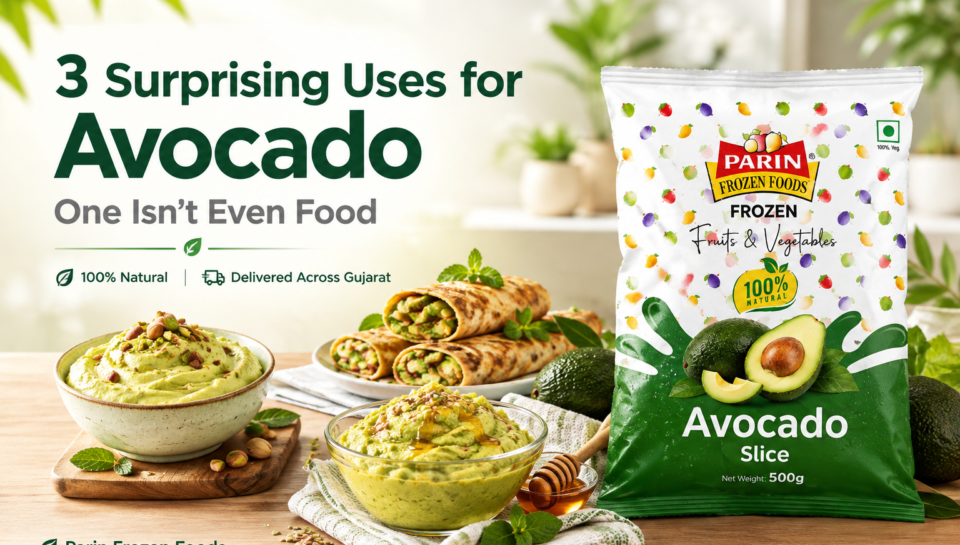
3 Surprising Uses for Avocado
Most people run out of avocado ideas after toast, a smoothie, and maybe a salad. Fair enough — the internet’s avocado content is fairly repetitive, and there isn’t much reason to look further unless something explicitly points you there.
So here are three genuinely different directions to take a pack of frozen avocado slice — a dessert twist Gujarati households will recognise instantly, a practical fix for picky-eater tiffins, and a skincare use that has nothing to do with eating avocado at all.
1. Avocado Shrikhand
Shrikhand is one of the easiest Gujarati desserts to adapt to avocado, mostly because its base — hung curd, sugar, cardamom — is already close in texture to mashed avocado. Blending the two together creates a version that’s noticeably lighter than traditional shrikhand, since avocado’s natural creaminess lets you use less curd fat overall while still landing on a rich, smooth result.
How to make it: Hang curd for a few hours to remove excess whey, then blend it with a thawed avocado slice, sugar or jaggery to taste, a pinch of ground cardamom, and a few strands of saffron if you have them on hand. The colour comes out a soft, pale green rather than the traditional yellow — different enough that it tends to make people curious rather than dismissive when they see it on the table. Serve chilled, garnished with chopped pistachios, exactly the way you’d serve regular shrikhand alongside puri.
This works particularly well during festivals and family gatherings where shrikhand already makes a routine appearance. It gives you a talking-point variation without abandoning a dish everyone already loves, and it’s a low-risk way to introduce avocado to family members who might be skeptical of the fruit in its more obviously “Western” forms like toast.
One practical note: make a small batch first. The flavour is different enough from traditional shrikhand that it’s worth confirming your family’s taste for it before committing a full quantity of curd and avocado to the recipe.
Why frozen avocado works well here: Because the avocado is going into a blender alongside curd rather than being sliced for presentation, the softer texture of thawed avocado is actually an advantage — it blends into a smoother base faster than firmer, fresh avocado would.
2. Avocado Mash for Kids’ Tiffins
Getting a picky eater to finish a full lunchbox is a familiar daily struggle in most households, and avacado’s mild flavour and soft, naturally sweet-ish taste make it an easier sell to children than most vegetables — especially compared to anything green and leafy that announces itself immediately.
A simple approach: Mash a thawed avacado slice with a small pinch of salt and a few drops of lime, then spread it onto a plain paratha or thepla and roll it up, slicing into bite-sized pinwheels. Packed cold, it holds its texture reasonably well through a few hours in a tiffin box, and it travels noticeably better than a fresh, cut avocado would — fresh avocado tends to brown visibly by lunchtime, which alone can put a child off eating it, regardless of taste.
A slightly more elaborate version works well for slightly older kids: mix the mashed avocado with a small amount of grated cheese and a pinch of chaat masala before rolling it into the paratha, which adds a flavour most children respond to positively.
For younger children just being introduced to solid foods, plain mashed avacado — with no salt or spice added — is commonly recommended as an early food by paediatric nutrition guidance, largely due to its soft texture and nutrient density. The American Academy of Pediatrics has detailed guidance on introducing foods like avocado to infants, including appropriate ages and preparation. As always, check with your child’s doctor before introducing any new food, particularly regarding timing and any family history of allergies.
Why frozen avocado works well here: Because it’s sold in individually frozen slices, you can thaw exactly one portion for a single tiffin without needing to use up a whole fresh avocado in one sitting — useful for a food that browns as quickly as this one does once cut.
3. Avocado Face Pack (Not for Eating)
This last one steps outside the kitchen entirely, but it’s worth including because it’s a genuinely common household use for avacado in many parts of India. Mashed avacado applied directly to the skin is a traditional home remedy for dryness, largely due to its high fat content acting as a natural moisturiser.
A simple version: Mash a thawed avacado slice with a spoon of honey and apply to a clean face, leaving it on for about fifteen minutes before rinsing off with lukewarm water. Many households add a small amount of curd or besan to the mix for a mild exfoliating effect — similar in principle to how besan and curd are already staples in traditional Gujarati skincare routines, just with avacado added into the combination.
For those with drier skin specifically, a version with just avacado and a few drops of honey, without any besan, tends to feel less tight afterward, since besan can be slightly drying on its own for some skin types.
This isn’t a medical treatment and shouldn’t replace advice from a dermatologist for any specific or persistent skin concern. But as an occasional, low-cost, natural moisturising treatment, it’s a genuinely reasonable option — and one that fits comfortably alongside skincare ingredients Gujarati households are already familiar with, even though avacado itself is a relatively new addition to the mix.
Why frozen avacado works well here: For a face pack, you don’t need much — often just a quarter to half a slice per use — so being able to thaw a small, exact portion from frozen avoids wasting most of a whole fresh avocado on a single skincare application.
A Few Notes Before You Start Experimenting
Start with small quantities. Avacado’s flavour is mild but its fat content is significant. In something like dal or chaas, a little genuinely goes a long way — start with half a slice and adjust up rather than the reverse.
Add avocado toward the end of cooking, not the beginning. Prolonged heat changes avacado’s texture and can introduce a slightly bitter edge. In thepla dough it’s fine mixed in raw, but in cooked dishes like dal or sabzi, stir it in close to serving time.
Thaw only what you need. Since frozen avocado slice is sold in individually frozen pieces, you can take out one or two slices at a time rather than defrosting the whole pack, which keeps the rest fresh for your next attempt at one of these five ideas.
Taste as you go. Because these aren’t traditional preparations, there’s no fixed “correct” amount of avocado to add. Treat the quantities above as a starting point, not a strict rule.
What to Look for When Buying Frozen Avocado
Check that the only ingredient listed is avocado, with no added oil or preservatives beyond a touch of natural citric acid to prevent browning, which is standard and not a concern.
Look for individually frozen slices that are loose in the bag rather than stuck together in a solid block — a sign the product was frozen properly at the right ripeness rather than bulk-processed. Check the colour: a healthy, consistent green-to-yellow flesh is what you want; significant browning suggests the fruit was already too ripe before freezing.
FSSAI licensing should be the baseline for any supplier, and APEDA registration is a further sign that the manufacturer follows export-grade quality standards. If you want to look deeper into avocado’s fat and nutrient profile beyond what’s covered here, the USDA FoodData Central database has detailed, publicly available nutrition data.
Storing Your Avocado Slice
Keep the pack in the main body of your freezer at a steady −18°C or below — not the door. Properly stored, frozen avocado slice holds its quality for roughly 8 to 10 months.
Thaw only the amount you need for a given recipe, either in the refrigerator for a couple of hours, or in a bowl of cool water for about 15 to 20 minutes if you’re short on time. Once thawed, use it within a day, and avoid refreezing — avocado in particular browns and loses flavour quickly once thawed.
Frozen Avocado Slice — Available at Parin Frozen Foods
At Parin Frozen Foods, our avocado slices are cut from fruit at peak ripeness and individually frozen to lock that ripeness in — so whether you’re trying avocado chaas this weekend or avocado thepla next month, the fruit is ready exactly when you are.
Product: Avocado Slice (1 KG.) What’s in it: 100% natural avocado, no added preservatives Certification: FSSAI licensed, APEDA registered Delivery: All cities across Gujarat and metro cities in India, packed in insulated boxes to protect the cold chain
Whether you’re experimenting in a home kitchen in Rajkot, or running a café or health-food counter in Ahmedabad or Surat that wants to offer something beyond the usual avocado toast, we deliver quality-checked frozen avocado slice straight to your door.
For bulk orders — cafés, health-food businesses, caterers — call us at +91 96384 67400 or +91 96384 67800, or email parinfrozenfoods@gmail.com for pricing on larger pack sizes.
Take a look at our other frozen fruit products too, including Litchi Slice, Kesar Mango Pulp, and Strawberry Whole — or browse our full product range — all processed and packed at our facility in Rajkot, Gujarat.
Frequently Asked Questions
Will avocado change the taste of my dal or chaas noticeably? Not dramatically. Avocado has a mild, slightly nutty flavour, so in small quantities it mostly adds creaminess rather than a distinct “avocado taste.” Start small and adjust to your preference.
Can I use frozen avocado directly in cooking, or do I need to thaw it first? For dishes like dal or sabzi where it’s added near the end of cooking, you can add small frozen pieces directly — they’ll soften quickly in the heat. For chaas, thepla dough, or chutney, thaw it first for easier blending.
Is avocado safe to add to traditional Gujarati dishes, or does it clash? There’s no health concern with combining avocado into these dishes. Whether the flavour combination appeals to you is a matter of taste — these five ideas are a starting point for experimenting, not a fixed rulebook.
How long does frozen avocado slice last? Around 8 to 10 months if stored properly at −18°C or below, unopened.
Does your avocado slice contain any additives? No, it’s 100% natural avocado with no added preservatives.
Do you deliver avocado slice outside Gujarat? We deliver across all cities in Gujarat and to metro cities in India. Contact us to confirm delivery to your specific location.
Can I order avocado slice in bulk for my café or restaurant? Yes. We supply bulk quantities to cafés, health-food businesses and restaurants across Gujarat. Call +91 96384 67400 for wholesale pricing and pack sizes.